


Let me tell you something that should make you angry.
Roughly one-third of humanity is walking around iodine-deficient right now. Not low on some obscure trace mineral nobody needs — low on the ONE element your body physically cannot build a single hormone without. No thyroid hormone. No estrogen, progesterone, or testosterone in the right amounts. No proper insulin or growth hormone. All of it depends on iodine.
And yet the textbooks still call iodine a minor player you should take in tiny amounts “because of its dangers.”
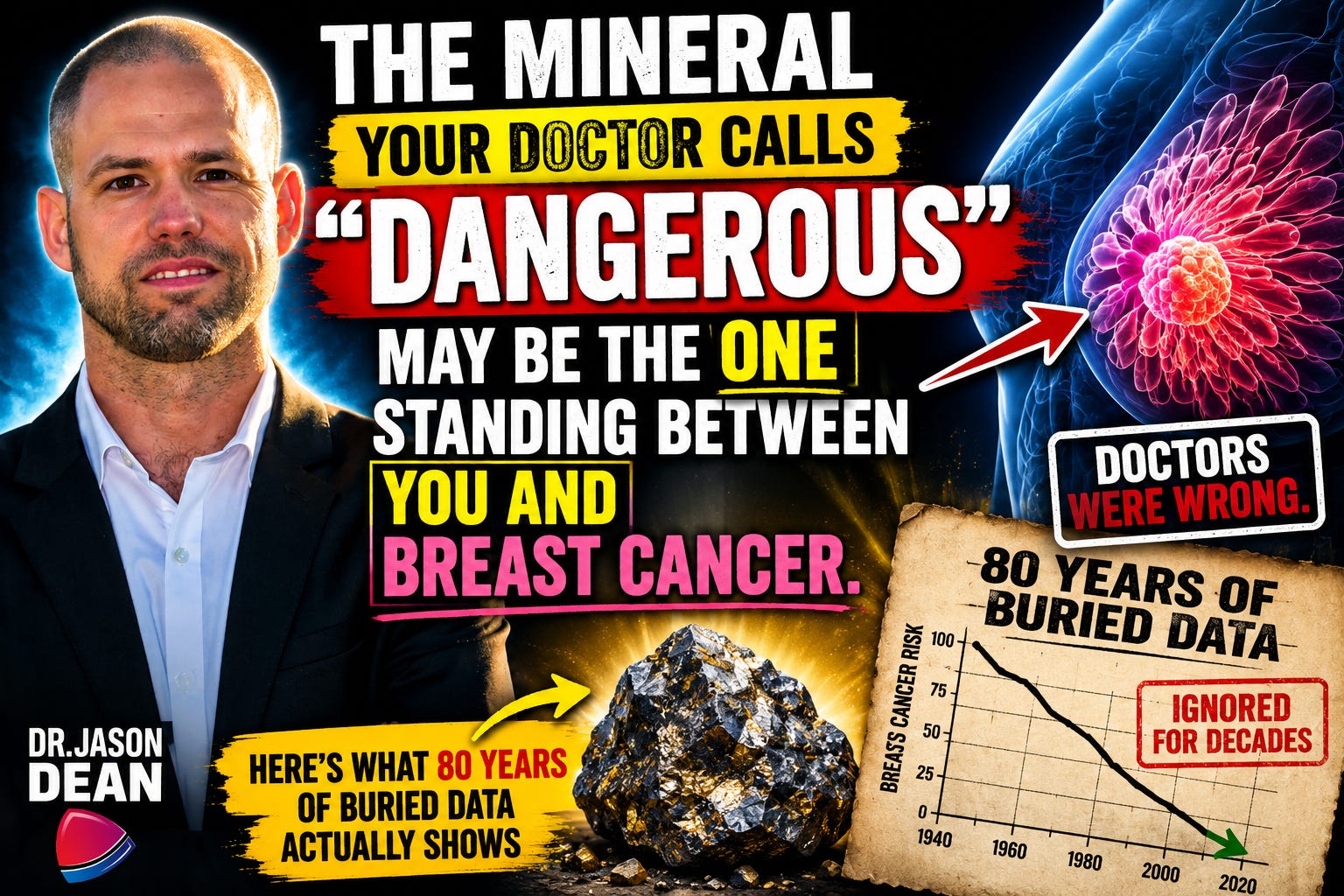
Meanwhile, breast cancer went from 1 in 20 women in the 1960s to 1 in 8 today — climbing about 1% every single year. Over that same window, we quietly pulled iodine out of the food supply and swapped in a chemical cousin (bromine) that actively poisons your thyroid.
That’s not a coincidence. That’s a pattern. Here are the 7 things the research shows about iodine and cancer that almost nobody is telling you.
1. The Deficiency Match
Look up the number. One out of seven U.S. women is iodine-deficient on a urine test (below 50 µg/L). One out of eight will develop breast cancer. Those two numbers track each other almost perfectly — and researchers have been pointing at it for decades.
When two lines on a graph move together this cleanly, you stop calling it a coincidence and start asking what’s driving it.
2. The Backwards Prescription
When a woman shows up with a goiter or low-thyroid symptoms, nearly every doctor in America reaches for a thyroid hormone prescription pad — without ever checking her iodine. That can be exactly the wrong move.
In a mammography screening group, women on thyroid hormone had double the breast cancer rate of women who weren’t (12.1% vs 6.2%). On it for 15+ years? 19.5%. Just 5 years? 10%. The longer you paper over an iodine problem with hormones, the higher the risk climbs.
3. The Root-Cause Fix
Treat the deficiency, not just the symptom. In the Hintze trial, one group got iodine and the other got levothyroxine (Synthroid) for eight months. Both shrank the goiter. But four months after stopping, the Synthroid group’s thyroids ballooned right back — while the iodine group’s stayed normal.
One treatment managed a symptom. The other actually repaired the tissue. That’s the whole difference between conventional and functional medicine in a single study.
💡 P.S. — Before you read on: If you’ve got a thyroid diagnosis, “borderline” labs, or a family history of breast cancer, the single most useful thing you can do is find out whether iodine is the missing piece before you spend another year on a prescription that may be treating the wrong problem. That’s exactly what I do with patients in a functional thyroid & iodine consult — we run the right testing and build a plan around your actual chemistry, not a guess. Book here 👉 www.drjasondean.com/mvx
4. The Geography Test
Follow the map. Japan and Iceland — high iodine intake (think sea vegetables and fish) — have low goiter AND low breast cancer. Mexico and Thailand — low iodine — have high goiter AND high breast cancer.
When the same relationship holds across four countries on three continents, geography stops being a travel fact and becomes evidence.
5. The Michigan Mistake
Learn from a real-world experiment we already ran. From 1924–1951, Michigan iodized its bread and goiter rates collapsed from 38.6% to 1.4%. Critics said “see, breast cancer didn’t budge, so iodine doesn’t matter.”
But Ghent and Eskin showed the catch: protecting the breast takes 20 to 40 times more iodine than protecting the thyroid. We were dosing for the goiter — nowhere near enough to protect the breast tissue. Then in the last few decades we removed even that and replaced it with bromine, a goitrogen. Illogical doesn’t begin to cover it.
6. The Hungry Breast
Understand why women are hit hardest. Your breasts have an iodine-trapping system just like your thyroid — and they compete with it for every microgram you eat. That’s why goiter is 6 times more common in girls than boys at puberty, and why women with fibrocystic breast disease soak up 12.5% of an iodine dose versus 6.9% in normal breasts.
Translation: fibrocystic breasts are iodine-starved and pulling supply away from the thyroid. Feed both, and the picture changes.
7. The Cellular Bodyguard
This is the part conventional medicine ignores entirely. Iodine doesn’t just build hormones. It triggers apoptosis — your body’s built-in self-destruct button for defective and abnormal cells. It nudges cells to differentiate away from the dangerous undifferentiated (cancer-prone) type. And it lowers reactive oxygen species, cutting the oxidative load that drives degeneration.
In plain English: adequate iodine helps your body find and delete the exact rogue cells that turn into tumors. That’s a surveillance system you want fully staffed.
Here’s the bottom line.
We took a mineral that protects the breast, the thyroid, and the brain — the leading preventable cause of intellectual disability on Earth — and we replaced it with a thyroid poison. Then we act surprised when breast and thyroid cancer keep climbing.
You don’t have to guess where you stand. A 24-hour urine iodine test tells you plainly (below 50 µg/L is deficient). But most people never get it, because most doctors never order it. Endocrinologist Dr. Guy Abraham, formerly of UCLA’s Department of Endocrinology, was convinced nearly everyone needs iodine repletion until their stores are restored — and the protocols to do it safely are well established.
If you’ve been handed a thyroid prescription without a single iodine test — or you have fibrocystic breasts, a family history, or symptoms nobody can explain — stop waiting for the system to catch up. Let’s find out what your chemistry is actually telling you. I’ll run the right tests, read them properly, and build you a real plan.
Book your functional thyroid & iodine consult here 👉 www.drjasondean.com/mvx
Psst: the women who get ahead of this are the ones who tested early — not the ones who found out at a mammogram. Be the first kind.
This article summarizes findings and clinical opinions drawn from published research (originally compiled by Dr. James Howenstine, MD, 2006) and is for educational purposes only. It is not medical advice, and nothing here is a substitute for individualized care. Iodine repletion — especially at higher doses — should be done under the supervision of a qualified practitioner, particularly if you have autoimmune thyroid disease, are pregnant, or take thyroid medication. Always talk to your doctor before changing your treatment.